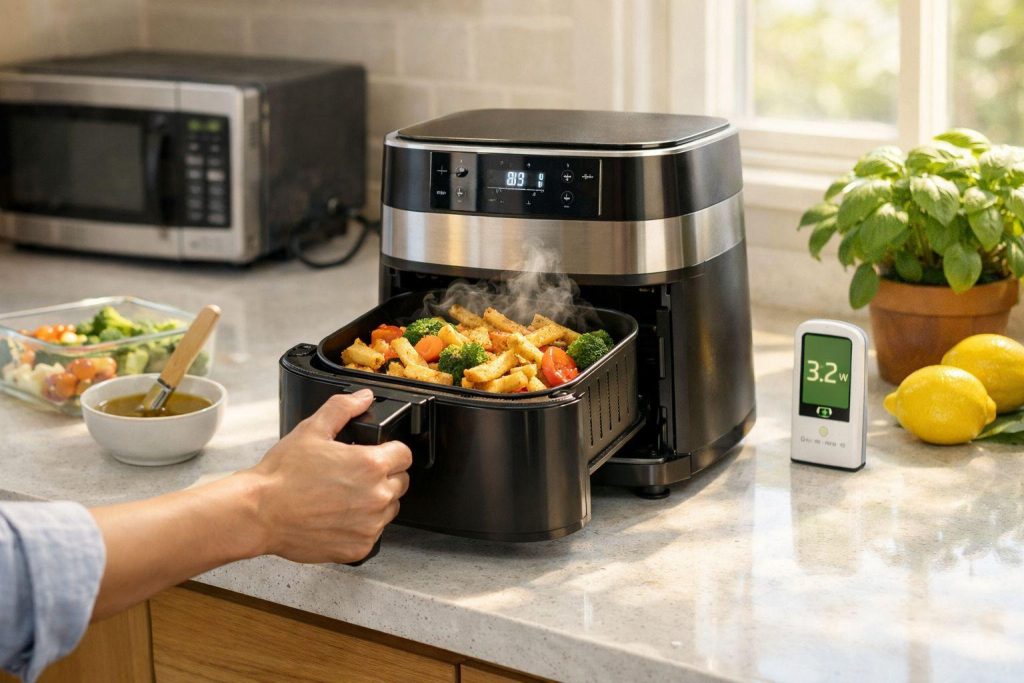
Running a farm teaches you to appreciate anything that saves a little time without compromising the quality of your work. I never expected a kitchen appliance to make much difference to my daily routine, but discovering the practical ideas behind Air Fryer Faz Tudo made me reconsider something surprisingly simple: perhaps the same resourcefulness we apply to farming belongs in the kitchen, too.
On a Farm, There’s Always Something More Important Than Cooking Dinner
There’s something deeply rewarding about farm life, but anyone who has managed a small farm or homestead knows that it rarely follows a predictable schedule.
The day might begin with feeding animals, checking fences, collecting eggs, or inspecting crops.
Then there’s equipment maintenance, watering, harvesting, cleaning, repairs, deliveries, and dozens of other tasks that somehow become urgent at the same time.
And just when you think everything is finished, something else needs attention.
A gate won’t close properly. An animal needs checking. The weather changes unexpectedly, and suddenly a job that could have waited until tomorrow becomes today’s priority.
By the time evening arrives, preparing a complicated meal isn’t particularly appealing.
What I want at that point is something straightforward: a warm, satisfying dinner made from ingredients I already have.
Preferably without spending another hour cooking and cleaning.
That’s why I started looking at the air fryer differently.
I’d always considered it a convenient appliance for busy households, but the more I thought about it, the more I realized how naturally it could fit into the rhythm of a small farm.
Not as a replacement for the traditional farmhouse kitchen.
And certainly not as a solution to every cooking problem.
But as a practical tool that makes certain everyday meals easier.
Farm Life Is About Efficiency, Even in the Kitchen
If there’s one principle that applies to almost every part of farming, it’s making good use of available resources.
Farmers understand the importance of planning ahead, avoiding unnecessary waste, and choosing tools that actually make work easier.
A piece of equipment doesn’t need to be impressive.
It needs to be useful.
And I think the same reasoning should apply to kitchen appliances.
An air fryer uses rapidly circulating hot air to cook food, often producing a browned or crispy surface without requiring the amount of oil used in deep-frying.
For small meals, it can also heat up faster than a conventional oven.
That doesn’t mean it is always the most efficient option.
If you’re preparing a large Sunday meal for several people, a full-size oven might make more sense.
But for an ordinary weekday dinner, especially when only one or two people are eating, an air fryer can be remarkably convenient.
The real benefit isn’t necessarily saving enormous amounts of time.
It’s reducing the number of small tasks that make cooking feel exhausting after a long day.
Fresh Ingredients Are Everywhere, but There’s Not Always Time to Cook Them
One of the privileges of living on a farm is having access to ingredients that come directly from the land.
Depending on the type of farm and the season, that might mean fresh eggs, potatoes, tomatoes, zucchini, peppers, herbs, or other vegetables.
Of course, not every farm produces its own food.
Some operations focus entirely on livestock, grain, or commercial crops.
But for those of us who maintain a vegetable garden alongside our farming activities, the kitchen can become an extension of the harvest.
And that’s one of the things I find most satisfying about using an air fryer.
It encourages simple cooking.
You don’t need elaborate sauces or complicated techniques to make fresh vegetables enjoyable.
A few ingredients, a little seasoning, and the right cooking time can produce something genuinely delicious.
Turning Garden Potatoes Into a Quick Side Dish
Potatoes are one of the first foods that come to mind.
Whether they’re grown on the property or purchased locally, they’re inexpensive, versatile, and filling.
For a simple dinner, I like the idea of washing a few potatoes, cutting them into evenly sized wedges, and tossing them with a little olive oil, salt, paprika, and rosemary.
At approximately 375°F (190°C), potato wedges may take around 18 to 25 minutes, depending on their thickness.
Shaking the basket during cooking helps them brown more evenly.
The result can be a satisfying side dish without heating a large oven or filling a pan with oil.
Pair those potatoes with eggs, grilled meat, or a serving of beans, and dinner starts coming together with very little complication.
That’s exactly the kind of cooking that makes sense after a busy day outdoors.
Garden Vegetables Don’t Need Complicated Recipes
I’ve always liked the idea that a productive garden should make everyday cooking simpler.
But sometimes, having an abundance of vegetables creates a different problem.
You have zucchini that needs using, peppers that are perfectly ripe, carrots from a recent harvest, and perhaps a few onions waiting in storage.
The challenge isn’t necessarily having enough food.
It’s finding the time and energy to prepare it.
An air fryer offers a practical way to cook small batches of vegetables without much equipment.
Zucchini, Peppers, and Onions
A handful of chopped zucchini, peppers, and onions can become a useful side dish.
Toss them with a small amount of oil, black pepper, and dried herbs.
Cooking at approximately 375°F (190°C) for 10 to 15 minutes can produce tender vegetables with lightly browned edges.
The exact timing depends on the size of the pieces and how full the basket is.
This type of preparation works particularly well with leftover rice, cooked beans, chicken, or a simple salad.
It’s also flexible.
If one vegetable isn’t available, substitute another.
That’s something farm life teaches us naturally: make the most of what you have rather than insisting on a perfect list of ingredients.
Carrots and Root Vegetables
Carrots, parsnips, and other root vegetables can also work well in an air fryer.
Because they’re relatively firm, cutting them into similar-sized pieces helps ensure even cooking.
A little oil, thyme, and black pepper can be enough to bring out their natural sweetness.
Depending on the vegetable and thickness, cooking may take around 15 to 25 minutes at 375°F (190°C).
More importantly, I don’t need a complicated recipe every time I harvest something.
Sometimes the simplest preparation allows fresh ingredients to speak for themselves.
Fresh Farm Eggs Are Too Useful to Overlook
Eggs are among the most versatile ingredients available to households that keep laying hens.
They can turn a basic meal into something more substantial, especially when paired with vegetables and whole-grain bread.
And while I wouldn’t replace my frying pan for every egg dish, an air fryer can be useful for small baked preparations.
For example, beaten eggs can be combined with cooked vegetables and poured into an appropriately sized, air-fryer-safe baking dish.
A small vegetable frittata can be cooked at approximately 325°F (160°C), with the time adjusted to the depth of the mixture.
The eggs should be fully set and reach a safe internal temperature of 160°F (71°C).
The convenience comes from being able to prepare a small portion without using a large oven.
But there’s another point I think is important.
Farm-fresh eggs still require proper food safety precautions.
Eggs collected directly from chickens aren’t automatically safer than store-bought eggs, and they shouldn’t be left sitting indefinitely at room temperature.
Collection, handling, refrigeration, and cooking practices all matter.
Good farming habits should continue in the kitchen.
When Farm Work Runs Late, Dinner Needs to Be Practical
Some days on a farm are simply unpredictable.
A task that should take thirty minutes ends up taking two hours.
An unexpected delivery interrupts the schedule.
Or the weather forces everyone to work longer than planned.
On evenings like those, the temptation to skip cooking altogether can be strong.
That’s when I appreciate having ingredients that require very little preparation.
A chicken breast with roasted vegetables.
A small portion of fish with potatoes.
A homemade vegetable patty with a salad.
Or simply reheating a properly stored meal prepared earlier in the week.
An air fryer can make these options more convenient, particularly when cooking for a small household.
A Simple Chicken and Vegetable Dinner
For example, a chicken breast can be seasoned with garlic, paprika, pepper, and a little oil.
Depending on its thickness, cooking at approximately 375°F (190°C) may take around 15 to 22 minutes.
However, time alone is never a reliable guarantee of safe cooking.
Chicken must reach an internal temperature of 165°F (74°C), measured with a food thermometer.
Vegetables can be cooked separately or alongside the chicken if the appliance has enough space and the ingredients can cook properly without cross-contamination.
With a portion of rice or potatoes, it becomes a straightforward meal.
Nothing particularly fancy.
But after a long day working outdoors, a simple homemade dinner can be exactly what you need.
The Air Fryer Can Help Reduce Small Amounts of Food Waste
Waste reduction is a subject that naturally matters to farmers.
Growing crops requires time, water, labor, and resources.
Throwing away perfectly usable food means losing some of that investment.
Of course, an air fryer isn’t a complete food-preservation system.
It won’t replace freezing, canning, refrigeration, or other established preservation methods.
But it can help make use of small amounts of food before they spoil.
A leftover baked potato can be reheated until pleasantly crisp.
Cooked vegetables can be incorporated into a small baked dish.
Yesterday’s properly refrigerated meal can become today’s lunch.
And a few vegetables that don’t quite make up a full recipe can be roasted together rather than forgotten in the refrigerator.
These may seem like minor improvements.
But I think small habits matter.
A farm doesn’t become more efficient because of one extraordinary change.
Often, efficiency comes from making dozens of ordinary decisions a little better.
What About Drying Farm-Grown Herbs?
Some air fryers also include a low-temperature dehydration function.
If the manufacturer specifically permits drying herbs and the appliance operates at an appropriate temperature, this can provide another way to use small garden harvests.
Rosemary, thyme, oregano, and sage are examples of herbs that can be preserved through proper drying.
However, a regular high-temperature air-frying program should not be used as a substitute for safe herb dehydration.
Loose leaves can also be moved by the fan, creating problems if they approach the heating element.
For larger harvests, a dedicated food dehydrator or an appropriate traditional drying method may be more practical.
It’s another example of why understanding the limitations of equipment is just as important as appreciating its advantages.
Less Cleaning Means More Time for Everything Else
If there’s one thing I don’t need after cleaning equipment, maintaining animal areas, and managing farm chores, it’s another complicated cleaning job.
That’s where I find the air fryer especially appealing.
With many simple meals, the cleaning can involve just the removable basket, tray, and perhaps one additional dish.
There’s no large roasting pan to scrub.
And when preparing foods that would otherwise be deep-fried, there’s no substantial quantity of used cooking oil to handle.
After each use, the appliance should be turned off, unplugged, and allowed to cool.
The removable components can generally be washed with warm water, mild dish soap, and a nonabrasive sponge, following the manufacturer’s instructions.
The electrical unit itself should never be submerged in water.
Cleaning the appliance regularly also helps prevent grease and food residue from accumulating.
But I wouldn’t leave it running unattended while heading back out to check animals or complete another chore.
It’s a cooking appliance, not a substitute for supervision.
For me, the goal is to simplify the kitchen without creating unnecessary risks.
Is an Air Fryer Really Economical for a Farm Household?
This is a question worth considering carefully.
Farmers tend to think about expenses in practical terms.
An item is only a worthwhile investment if the benefits justify its cost.
An air fryer may use less energy than a large oven when preparing small portions, particularly because it heats a smaller cooking chamber.
But that doesn’t mean it always consumes less electricity for every meal.
Actual energy use depends on power consumption, cooking time, portion size, and how efficiently the appliance is used.
A large conventional oven may be better suited to cooking several dishes simultaneously.
And if you have to run an air fryer through numerous batches to feed a large family, the advantage may disappear.
I would also consider how frequently the appliance would be used.
Buying an expensive model to cook potatoes once a month probably isn’t worthwhile.
But for a small farm household preparing quick meals several times a week, the convenience may justify the investment.
There’s also a less obvious consideration.
The value of a tool isn’t always measured exclusively in electricity or dollars.
Sometimes saving time, reducing cleanup, and making home cooking more manageable are meaningful benefits in their own right.
Farmhouse Cooking Doesn’t Have to Be Complicated
I love the traditions associated with farmhouse kitchens.
Freshly baked bread, slow-cooked meals, preserved vegetables, family recipes, and food prepared from ingredients grown close to home.
There’s something comforting about that way of cooking.
But I also think we sometimes romanticize it.
Traditional farm life involved enormous amounts of labor.
Preparing meals without modern appliances could be physically demanding and time-consuming.
And I don’t believe preserving rural traditions requires us to reject every technology that makes daily life easier.
A slow-cooked stew still deserves its place.
A cast-iron skillet remains incredibly useful.
And nothing about owning an air fryer means abandoning homemade bread, traditional baking, or family recipes.
The appliance simply offers another option.
A quick vegetable lunch doesn’t need to become a major cooking project.
A small portion of potatoes doesn’t always require preheating the oven.
And a tired farmer should be able to enjoy a good meal without feeling obligated to spend hours preparing it.
I think traditional farmhouse values are less about using a particular appliance and more about resourcefulness, care, and respect for ingredients.
How I’d Organize a Week of Simple Farm Meals
One of the easiest ways to make an air fryer useful is to plan meals around ingredients already available.
Rather than deciding on an elaborate recipe every evening, I prefer the idea of keeping a few reliable meal combinations in mind.
| Day | Simple farm-inspired meal |
|---|---|
| Monday | Air-fried chicken, garden potatoes, and green beans |
| Tuesday | Vegetable frittata with fresh eggs and whole-grain toast |
| Wednesday | Crispy roasted zucchini, cooked beans, and rice |
| Thursday | Fish with roasted carrots and potatoes |
| Friday | Homemade vegetable patties with salad |
| Saturday | Seasoned potato wedges with chicken and seasonal vegetables |
| Sunday | Traditional family meal using the oven, stovetop, or outdoor grill |
This isn’t meant to replace proper meal planning or suggest that every farm produces all these ingredients.
It’s simply a practical example of how an air fryer can complement a varied household menu.
The idea is to use it for the parts of a meal where it offers a genuine advantage.
Some foods will still be better boiled, steamed, grilled, or slow-cooked.
And that’s perfectly fine.
What an Air Fryer Can’t Do on a Farm
For all its convenience, an air fryer has obvious limitations.
It isn’t designed for preparing large quantities of food for farm crews.
It can’t replace a pressure canner, a food dehydrator, a commercial kitchen, or other specialized equipment.
It isn’t appropriate for soups or liquid-heavy stews.
And it won’t make every traditional farmhouse recipe taste the same as a preparation cooked in cast iron or over an open fire.
Capacity is another limitation.
Small baskets are convenient for one or two portions, but preparing a large family dinner may require several rounds of cooking.
There are also practical safety considerations.
Air fryers need a stable, heat-resistant surface, adequate ventilation, a suitable electrical outlet, and regular cleaning.
They should be kept away from combustible materials and shouldn’t be operated in dusty agricultural workspaces, barns, or areas where fuel and chemicals are stored.
I think recognizing those limitations makes the appliance more useful, not less.
Because the best way to use any tool is to understand exactly what it does well.
The Small Change That Made Farmhouse Cooking Feel Easier
What interests me most about this appliance isn’t its technology.
It’s how naturally it fits into a broader philosophy of practical living.
Running a farm teaches patience, but it also teaches efficiency.
You learn that not every job needs the biggest machine.
Sometimes a smaller, more specialized tool is exactly what’s needed.
I see the air fryer in much the same way.
It’s not the centerpiece of the farmhouse kitchen.
It doesn’t replace cooking skills.
And it certainly doesn’t change the fact that fresh ingredients and thoughtful preparation matter.
But it can make everyday meals less demanding.
It encourages me to think about quick combinations of vegetables, proteins, and simple sides rather than relying entirely on complicated recipes.
It also makes small portions more convenient, which can be helpful when people working on a farm eat at different times.
And there’s something appealing about finishing a long day with a meal that tastes homemade without creating another hour of work.
That’s the kind of convenience I can appreciate.
Frequently Asked Questions About Using an Air Fryer on a Farm
Is an air fryer useful for farmers and homesteaders?
Yes, particularly for small households that need convenient meals during busy workdays. It can cook vegetables, potatoes, poultry, fish, and other foods without requiring a large oven for every meal.
Can I cook fresh farm vegetables in an air fryer?
Absolutely. Potatoes, zucchini, carrots, peppers, onions, and many other vegetables can be prepared using hot-air cooking. Times and temperatures depend on the size and type of vegetable.
Can farm-fresh eggs be cooked in an air fryer?
Yes. Eggs can be incorporated into small baked dishes such as frittatas, using a suitable baking pan. Proper egg handling and safe cooking temperatures remain important.
Does an air fryer save electricity compared with an oven?
It may use less energy for small portions because it generally heats a smaller space. However, actual savings depend on the model, cooking time, quantity of food, and comparison appliance.
Can an air fryer help reduce food waste on a farm?
It can help use small quantities of fresh ingredients and reheat properly stored leftovers. However, it does not replace safe food-preservation methods such as freezing, canning, or controlled dehydration.
Is an air fryer suitable for feeding an entire farm crew?
Usually not if it’s a small household model. Larger quantities may require several batches, making a conventional oven or commercial cooking equipment more efficient.
Can an air fryer replace traditional farmhouse cooking?
Not completely. It works best as a complementary appliance for quick meals, small portions, and certain side dishes. Traditional ovens, stovetops, grills, and slow cookers remain useful for many farmhouse recipes.
Conclusion: Sometimes the Best Farm Tools Are the Unexpected Ones
Farm life has taught me that efficiency isn’t about doing everything faster.
It’s about using time and resources wisely.
Some tasks deserve hours of careful attention. Others can be simplified without losing anything important.
I think cooking belongs in both categories.
There will always be days when I want to prepare a traditional meal, bake bread, or spend time in the kitchen making something special.
But there are also evenings when all I need is a practical dinner made from fresh ingredients after a demanding day outdoors.
That’s where an air fryer can make a difference.
It can help turn garden vegetables into quick side dishes, prepare small portions of meat or fish, make use of leftovers, and reduce some of the cleanup that follows cooking.
It won’t replace the farmhouse kitchen.
And I wouldn’t want it to.
But it can become one of those modest tools that makes everyday life run a little more smoothly.
Because when you manage a farm, the most valuable kitchen appliance isn’t necessarily the one that does the most. It’s the one that helps you enjoy a good meal without taking unnecessary time away from everything else that needs your care.
And if a small air fryer can make that possible on even a few busy evenings each week, I’d consider it a useful addition to the farmhouse kitchen.